
Some Seattle homes have never had their wiring touched since the day they were built, and depending on the neighborhood, that day could have been seventy or eighty years ago. Wiring doesn’t announce its age the way a kitchen or a roof does. It just sits behind the walls, quietly falling further behind what the home actually needs from it, until something forces the issue.
In-House Electric has been rewiring Puget Sound homes since 2009: full-house rewires, room-by-room phased upgrades, and everything in between. We tell you exactly what we find, what it’ll take to fix it, and what it’ll cost before a single wall gets opened.


Roughly 43% of Seattle’s housing stock was built before 1980, and the city’s median home dates to around 1985, which means a large share of local houses were wired for a world without EV chargers, induction ranges, multiple laptops charging at once, or central air. That gap between the original design and today’s actual load is exactly where rewiring conversations start.
It’s not just about capacity, either. Two specific wiring types show up constantly in older Seattle homes: knob-and-tube, common in houses built before the 1950s, and aluminum branch wiring, common in the 1960s and ’70s. Both carry documented fire risk that capacity upgrades alone don’t solve.


Knob-and-tube wiring runs individual conductors through ceramic knobs and tubes rather than a sheathed cable, with no ground wire at all. It wasn’t built for insulation contact, and decades of attic insulation piled on top of it (common in older Seattle bungalows) creates a heat-trapping fire risk the original installers never accounted for. Many insurers won’t write or renew a policy until it’s gone.
Aluminum branch wiring expands and contracts more than copper does at the connection points, which loosens screws and devices over time and creates exactly the kind of high-resistance connection that overheats and arcs. It’s not automatically dangerous; a lot depends on the connectors used at outlets and switches. But it needs an electrician’s eyes on it, not a guess.
We replace both with modern copper branch circuits, properly grounded, sized for actual present-day load rather than just matching what was there before.

If two or more of these sound familiar, it’s worth having an electrician actually open the panel and take a look rather than guessing from the symptoms alone.
Not every home needs the same scope, so the process starts with figuring out which one yours actually needs:
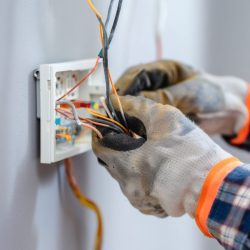
Rewiring costs vary based on your home’s square footage, how accessible the wiring is behind walls and ceilings, whether your home has plaster-and-lath construction or modern drywall, and whether a panel upgrade gets bundled into the same project. A partial or room-by-room rewire costs proportionally less than a full-home rewire and lets you spread the work, and the investment, over time. Because every home’s layout and wiring condition is different, we don’t quote a number sight unseen. You’ll get a clear, written estimate after the initial on-site evaluation, with the full scope laid out before any work begins.



We rewire homes throughout Seattle, including Ballard, Fremont, Wallingford, Magnolia, Queen Anne, Capitol Hill, Greenwood, Phinney Ridge, West Seattle, and the University District. Searching for “home rewiring near me” and don’t see your specific block listed? Call (425) 760-3203 or send a quick message through our contact form, and we’ll confirm coverage for your address directly.
Old wiring doesn’t get safer by waiting. It just gets more expensive to ignore, especially once it starts affecting a home sale, an insurance renewal, or a remodel that’s already underway. In-House Electric will tell you exactly what’s behind your walls and what it’ll take to fix it, before any work starts.
Call (425) 760-3203 or request an evaluation online to get started.
Usually not. We work in stages and keep power running to the rest of the home while the active section is being rewired. Full vacate-the-house projects are rare outside of major renovations already in progress.
A single-story home typically takes about a week to ten days from start to final inspection; larger or multi-story homes, or homes with plaster walls, can run two to three weeks. We’ll give you a realistic timeline after the initial evaluation.
Some will, particularly if a home inspection flagged knob-and-tube wiring or if you’re renewing a policy on an older home. We can provide documentation your insurer can use either way.
Knob-and-tube’s main risk is heat buildup from insulation contact and general age-related insulation breakdown. Aluminum wiring’s main risk is loose, overheating connections at outlets and switches over time. Both are manageable, but neither should be left unaddressed indefinitely.
Yes, a phased, room-by-room approach is common, especially around a kitchen or bathroom remodel. It costs less upfront and lets you prioritize the areas with the worst wiring first.
We handle it completely: application, scheduling the inspection, and making sure the work passes the first time.
