
A full main panel doesn’t always mean you need a whole new panel. Often it just means your power isn’t reaching the right places, and a properly placed sub panel solves that without touching your main service at all.
In-House Electric installs and repairs sub panels across the Puget Sound region, for garages, ADUs, basements, workshops, and anywhere else a property needs its own dedicated set of circuits. Every installation is sized for the actual load, grounded correctly, and permitted through SDCI from the start.


A sub panel is fed from your main panel and distributes power to a specific area of your property, like a detached garage, a finished basement, or a backyard ADU. It doesn’t add total capacity to your home. What it does is give a defined space its own breakers, so you’re not running extension cords across the yard or maxing out a single circuit every time you plug in a second tool.
In Seattle specifically, a few situations come up constantly:


If any of these sound familiar, the right move is usually a sub panel rather than a full main panel replacement, though we’ll tell you honestly if your situation actually calls for the latter instead.
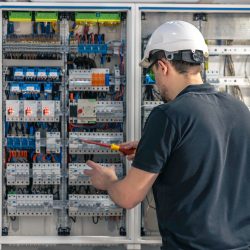

Every sub panel we install meets NEC requirements and Washington state regulations, and every detached structure installation includes proper grounding and, where required, its own main disconnect. An improperly installed sub panel can void insurance coverage, fail a permit inspection, or create a real shock or fire hazard, so we don’t treat this as a quick add-on job. It gets the same code-compliance attention as a full panel replacement.




Pricing depends heavily on the sub panel’s amperage, its distance from the main panel, and whether it’s feeding an attached or detached structure. Detached installations, like a backyard ADU or garage, generally cost more than attached ones at the same amperage, mainly because of the trenching, conduit, and separate grounding a detached structure requires, not the panel hardware itself. Because every property’s layout is different, we don’t quote a number sight unseen. You’ll get an exact, written figure after we’ve seen the site and confirmed what the install actually involves.
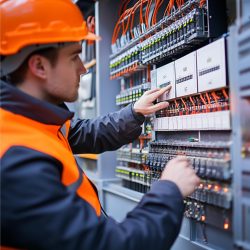


We install and repair sub panels throughout Seattle, including Ballard, Fremont, Wallingford, Magnolia, Queen Anne, Capitol Hill, Greenwood, Phinney Ridge, West Seattle, and the University District. Searching for “garage subpanel installation near me” and don’t see your specific neighborhood listed? Call (425) 760-3203 or send a message through our contact form and we’ll confirm coverage for your address.
Whether it’s a garage that’s outgrown its outlets or an ADU that needs its own dedicated power, In-House Electric will assess what you actually need and give you a clear plan and price before any work starts.
Call (425) 760-3203 or request an evaluation online to get started.
No. It redistributes existing capacity to a specific area rather than adding to your home’s overall electrical supply. If your home genuinely needs more total capacity, that points to a main panel upgrade instead, and we’ll tell you plainly if that’s the case.
If your main panel still has available capacity but a specific area like a garage or ADU needs its own dedicated circuits, a sub panel is usually the right answer. If your main panel itself is maxed out, undersized, or outdated, a main panel upgrade comes first, sometimes alongside the sub panel.
Yes, this is one of the most common installs we do in Seattle given the city’s ADU rules. Detached installations require a separate ground rod and typically a main disconnect, both of which we handle as part of the install.
Yes. Sub panel installation requires an SDCI permit and inspection. We file the application and manage the inspection scheduling for you.
If the issue is a faulty breaker or a loose connection, repair is usually the right call. If the panel is rusted, undersized, outdated, or simply doesn’t meet current code, replacement is the safer long-term option. We’ll assess and recommend honestly either way.
Yes, as long as it’s sized correctly for the dedicated 240 volt circuit an EV charger requires. We factor that into the sizing during the initial evaluation if EV charging is part of the plan.
